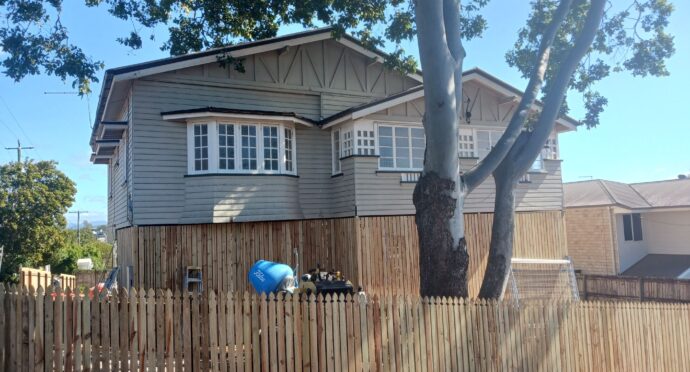
In July it will be 10 years since I wrote Case Study – High Growth Investment in Brisbane (still one of my most-read articles!).
This is a project Elise and I undertook personally. We’ve since lifted and shifted the existing house, completed renovations, and subdivided the block.
I thought it would be interesting to revisit the original strategy, compare it to what actually happened, and then to share some of the key lessons learned…
I’ve also included photos of the site and construction works to bring it to life a bit more.
The original purchase – recap
- Purchase price in 2016: $692,500
- Minor improvements shortly after buying: $25,000
With no further changes, and purely due to natural growth, the property is now conservatively worth $1.5 million, representing a $780,000 uplift.
However our original strategy was never a just a passive one. The plan was always to manufacture additional equity through subdivision and development.
As illustrated below, the opportunity was to:
- Lift, shift and renovate the existing character home
- Subdivide the block into two lots
- Create a new vacant block for a future home build
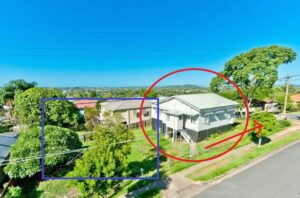
Development Application ‘DA’ approval was obtained in 2022 at a cost of $15,000. Then in 2025 we completed the subdivision and renovation works for a further $300,000. Here is an overview of the process as well as a cost breakdown…
Part 1 – DA approval (2022)
$15k – Assistance from town planner; Brisbane City Council approval
Part 2 – Civil design (3 months)
$11k – Assistance from civil engineer; additional approvals
Part 3A – Civil construction (4 months)
$36k – Earthworks, service connections e.g. sewer, water and stormwater connections
Part 3B – House lift, shift & renovation (concurrent with 3A)
$170k – House lift, steel support, concrete slab, house shift, new plumbing, minor bathroom renovation, new double garage, retaining walls on the vacant block to create level pad
Part 4 – Plan sealing & titling (1 month)
$30k – Infrastructure charges
$10k – Surveying, sealing & titling
Additional costs
$5k – Architect (house relocation and renovation plans)
$16k – Project management (subdivision)
$22k – Project management (house relocation & renovation)
We engaged a town planner/ architect for the DA processes as well as a separate on-the-ground project manager to coordinate the tenders and construction. Given this was an interstate project assembling the right team was very important.
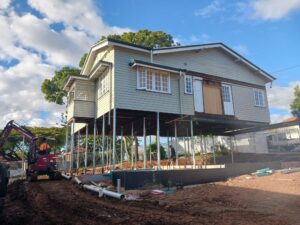
Pics from the development
The existing home being lifted and shifted
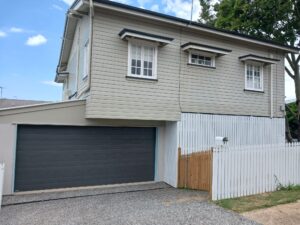
New double garage added to the existing home for improved amenity
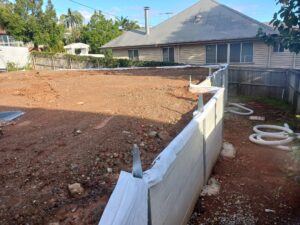
Retaining walls built on the vacant lot to create a level pad for the new home build
The outcome (manufacturing equity)
Post-completion, valuations came back as follows…
- Renovated dwelling on 405sqm lot: $1.125 million (JLL, September 2025)
- Vacant 405sqm construction-ready lot: $925,000 (CBRE, September 2025)
- Combined valuation: $2.05 million
So for an additional investment of $315,000, we increased the property’s value by approximately $550,000, compared to the starting (pre-development) value of $1.5 million.
This equates to:
- $235,000 manufactured gain from development
- Total uplift of just over $1.0 mil ($780k natural growth + $235k from development)
It’s a practical example of how strategic property development can help you build equity more quickly.
Key takeaways and lessons learned
- Buying a character home on a large, well-located block provided optionality. We deliberately chose value-add potential over a finished product.
- This was always a capital growth focused strategy rather than an income play and that turned out to be right.
- At the time, Brisbane offered superior land content and development potential compared to similarly priced Melbourne property nearer to where we lived.
- Approximately 80% of the total gain came from market growth; 20% came from development.
- Interstate development carries additional risk. The quality of the on-the-ground team we assembled has been very important.
What’s next
We are now considering Phase 2 of the development – constructing a new family home on the vacant lot. Of course this involves new sets of costs and risks, however the feasibility as it currently stands has merit.
I’ve updated and shared this case study not to recommended this style of investment to everyone, more to show what’s possible beyond the simpler ‘buy-and-hold’ strategy which we see more regularly.
If anyone would like further detail or to discuss how similar strategies may or may not suit their own objectives, I’m always happy to share additional insights.
Daniel Gold