
In our interview with property expert John Lindeman he talks about the need for young investors to focus on capital growth, rather than cash flow, to build their portfolios. (you can listed to the podcast recording here)
The rationale is that the capital growth creates equity, and the investor can use this equity to grow a larger portfolio.
As the investor then gets older, John’s advice is to transition investments towards higher yielding properties, which generate more income and can therefore support retirement.
In today’s post we’re providing a real life example of a growth orientated investment recently purchased (April 2016) in Brisbane.
Snapshot of the investment opportunity:
- 97 Suez Street Mitchelton QLD
- Growth suburb 8km from Brisbane CBD
- 2bdr, 1bth on 809sqm corner block
- One owner since being built in 1930’s
- 12ft ceilings, bay windows, large bedrooms, additional storage beneath home
- 750m from Mitchelton train station and local cafes/restaurants
- Renovation potential, possibly development potential as well
- Purchase price $692,500
Images of the property (prior to the purchase):
Images 1-3 – Helicopter view and streetscape.
Note the large corner block with space at rear for future subdivision and new build.
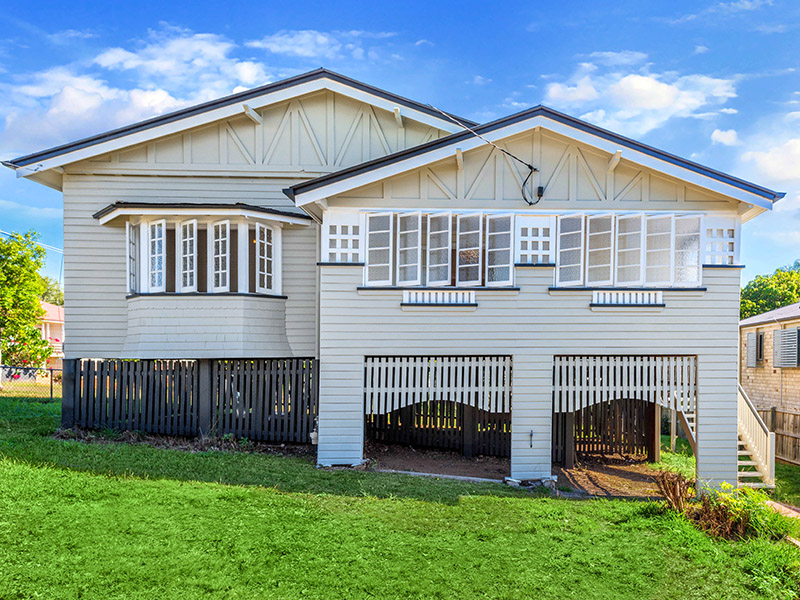
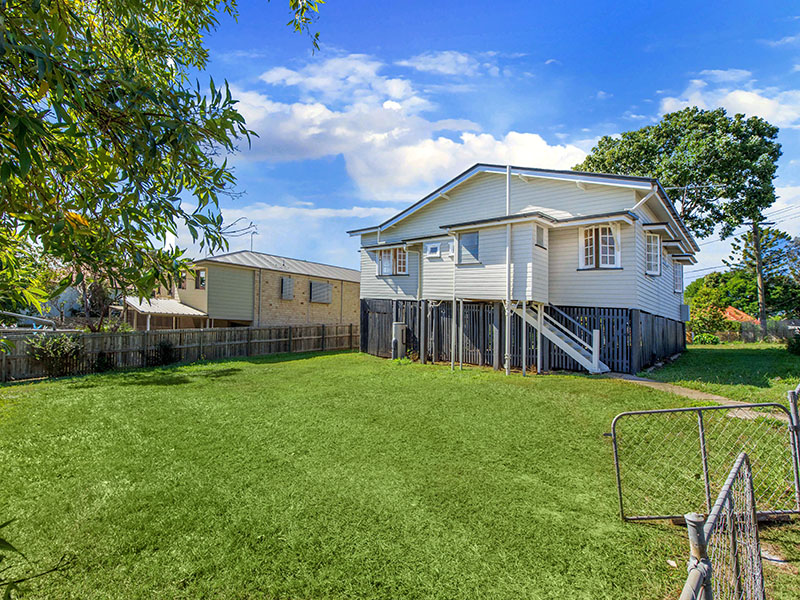
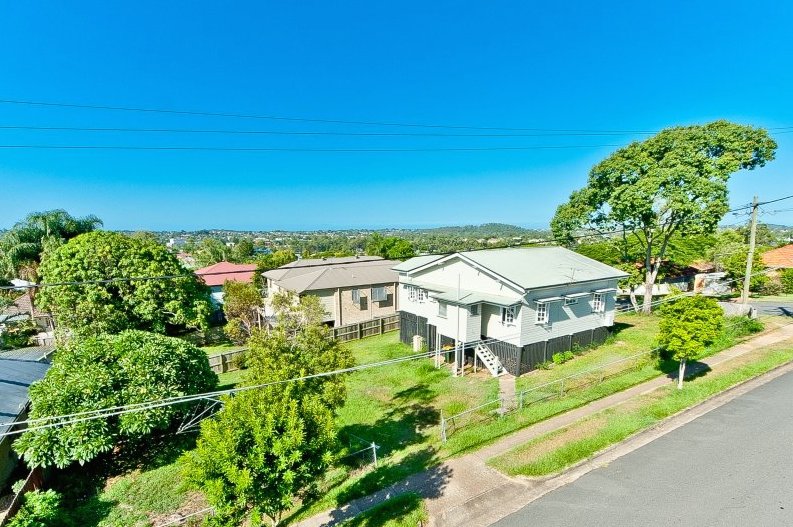
Image 4 – Floor plan
Note there are only 2 bedrooms and the kitchen is fully enclosed.

Image 5 – Lounge area, looking towards “study” and sunroom.
Note that the study (where the door’s closed) was actually being used as a storage room, the floor was carpeted and the walls were unpainted and in a terrible condition. Note the sunroom was also carpeted as well.
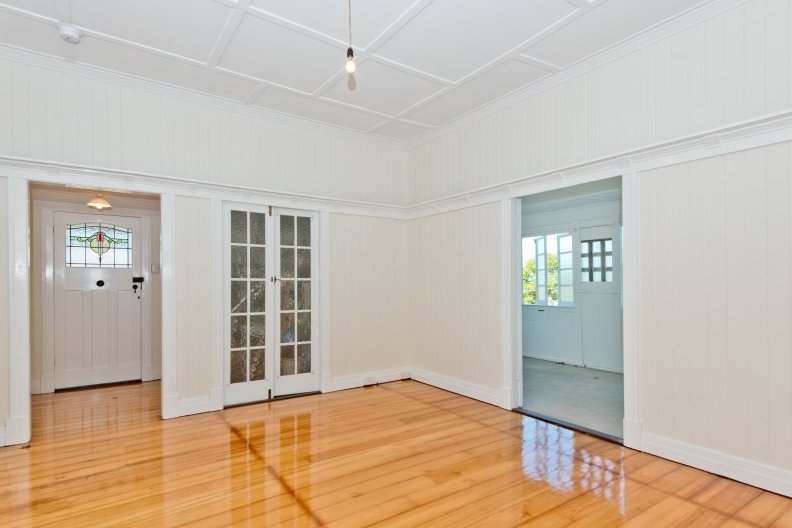
Image 6 – Unrenovated kitchen.
The original kitchen was fully enclosed, also there was no bench-space or room for fridge or dishwasher. Flooring is a very cheap lino.
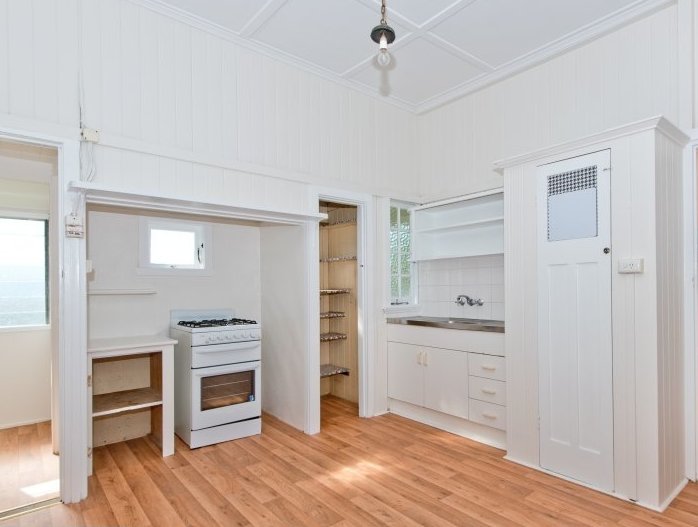
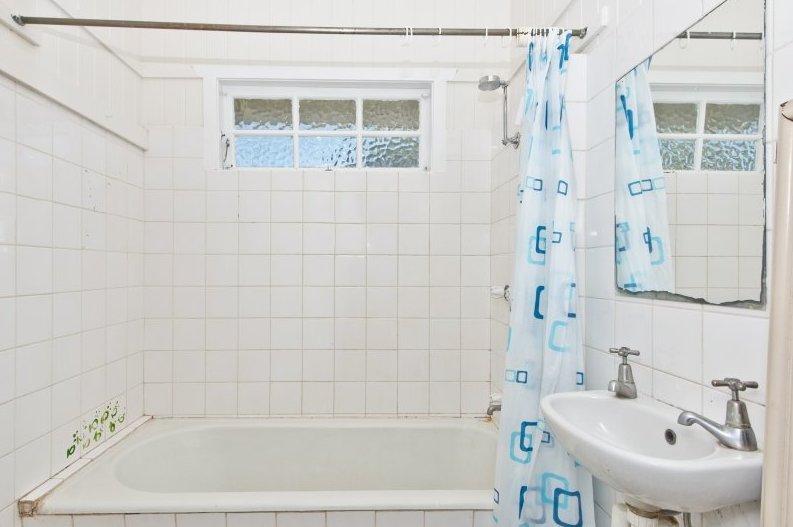
Image 7 – Unrenovated bathroom.
Note the cracked mirror, cheap shower curtain, dirty grouting and exposed pedestal vanity.
The investment overview/strategy was as follows:
- Investment grade suburb – 8km from Brisbane CBD, owner occupier appeal, increasingly desirable for young families/professionals with growing incomes
- Point of difference/scarcity – large land component, corner block
- High side of street and suburb, minor city view from master bedroom
- North facing, large street frontages (x2)
- “Potential” for good flowing floor plan
- Walking distance from public transport into city + cafes/shops
- Opportunity to add value through renovation, house raise and development (see below)
On face value one might assume owner-occupiers would be very attracted to this property, and therefore competition would be very high.
However this wasn’t exactly the case. Owner occupiers often prefer something already perfect, as that’s where their emotional connection comes from. They often want something they can move into immediately, without having to do any extra work.
So there were actually a number of turn-offs for owner occupiers with this property:
- Only 2 bedrooms (Mitchelton is a family friendly suburb where 3+ bedrooms is expected/mandatory, particularly on blocks of this size)
- The kitchen wasn’t renovated
- The bathroom wasn’t renovated
- The price point was significantly higher than most other 3 bedroom houses in the suburb (let alone median 2 bedrooms houses in the suburb) due to the land size
However there were also straightforward solutions for each of the above issues, they just required some time and money in order to be addressed.
The investor here had a very clear mandate for growth. To achieve this they were specifically targeting a large land component and with opportunities to add-value.
Once the property was identified the following short, medium and longer term plans for the asset were discussed and then documented.
- 1-2yr (short term) plan
- Minor renovation involving:
- New kitchen (install new island bench, dishwasher, fridge space and cupboards)
- Knock down wall between kitchen and living area to create open/free flowing floor plan
- Covert existing dining area into 3rd bedroom
- Convert storage area into proper study
- Convert sunroom into new dining space
- Floorboards throughout
- New bathroom vanity
- New hot water system
- New windows (identified in the building/pest report requiring attention)
- Cost $20k
- Let the market develop (2-3yrs), allow more time for the trend of higher incomes moving into the suburb to continue
- Minor renovation involving:
- 3-5yr (medium term) plan
- raise house and create additional bedroom + rumpus + bathroom downstairs (raising also improves city view)
- full bathroom renovation (new shower, dual vanity and tiles)
- cost $40k
- 7-10yr (long term) plan
- subdivide block and build 2nd house at rear (subject to council approval)
- cost $70k to subdivide plus $300-350k to build
- estimated value $650k for house 1 plus $750k for house 2 at today’s prices
- implied profit $270-320k
- plus further upside with market growth across 2 x assets (e.g. end values of $1.04 million (house 1) + $1.20 million (house 2) after 7 years assuming 7.0% p.a. growth)
In addition to the forecast market growth in this suburb, each of the above ideas also presents opportunities for the new owner to manufacture their own growth out of the asset.
Each enhancement also increases the desirability for owner occupiers who may be interested in the properties.
The investor proceeded with the purchase and it was eventually acquired through private tender for $692,500.
The vendor received bids from 5 different parties, however for the reasons described earlier there were less owner occupiers in the process which kept the pricing at reasonable a level.
There was no interest from developers because council regs for subdivisions as at Apr 2016 were for 450sqm minimum end lot sizes (here there’s only 809 sam / 2 = 404.5 sqm, slightly too small).
As part of the due diligence process however town planners and a civil engineer conducted a thorough review of the property which identified the lot sizes as being the only red-flag for the subdivision (there were no issues associated with infrastructure, service connections, protected vegetation etc.).
But through the due diligence process it was also discovered that the next door property had previously subdivided their block and built two new houses on it. This property had the same block size and overlays . Using this precedent an enquiry was lodged with Brisbane City Council Risk Smart (a service to quickly get low-risk development proposals approved by Brisbane City Council) and their response was favourable, they were happy to support a 1-into-2 application for subdivision. This changed the valuation equation greatly, but it was information no one else would have had, because it was unlikely they would have made the same kind of enquiries.
So with less owner occupiers, and no developers, competition for the property was less fierce than what it may have been otherwise. The main interested parties were actually owner/builders.
From the investor’s perspective it was a perfect opportunity to buy a high growth asset for a fair and reasonable price.
Consider the growth potential of this property against say a similarly priced $700k property in Sydney or Melbourne.
For $700k in Melbourne you would get a renovated but small 2 bedroom art deco apartment in Elwood (not in any way a “growth” investment), or a larger block say in a middle ring ungentrified suburb like Maidstone or Fawkner, approximately 20km from Melbourne CBD.
This 2bdr apartment in Elwood sold for 720k on the weekend:
http://www.realestate.com.au/property-apartment-vic-elwood-122893378
With 80% leverage on the Mitchelton/Brisbane investment the cost to run the asset would be only approximately $6,000 p.a. after-tax, say $3,720 p.a. after tax.
This implies growth rate of less than 2% p.a. to breakeven.
The property was successfully purchased on 25 April 2016 for $692,500.
Josh Masters spoke in our Long Property interview about not competing against too many owner occupiers when buying investment properties (to avoid the risk of overpaying, here’s a link to the interview). This case study provides a good example of that actually working in practice.
As per the property plan above, the minor/$20k renovation was then completed over a four week period, specifically with the objective to increase the owner occupier appeal.
This resulted in a finished product more in-line with the demands/expectations for houses in the area:
- 3 bedrooms plus study
- Separate dining area with views
- New kitchen with dishwasher and stone benches
- Open free flowing floor plan
- High owner occupier appeal
Here are some photos after the renovation:
Images 8-9 – Renovated kitchen (with new opening to lounge).
Fridge space, integrated stove top, new stone bench tops plus island, new dishwasher installed beneath island.
Note also the wall between the kitchen and lounge has been removed to create the free flowing floor plan.
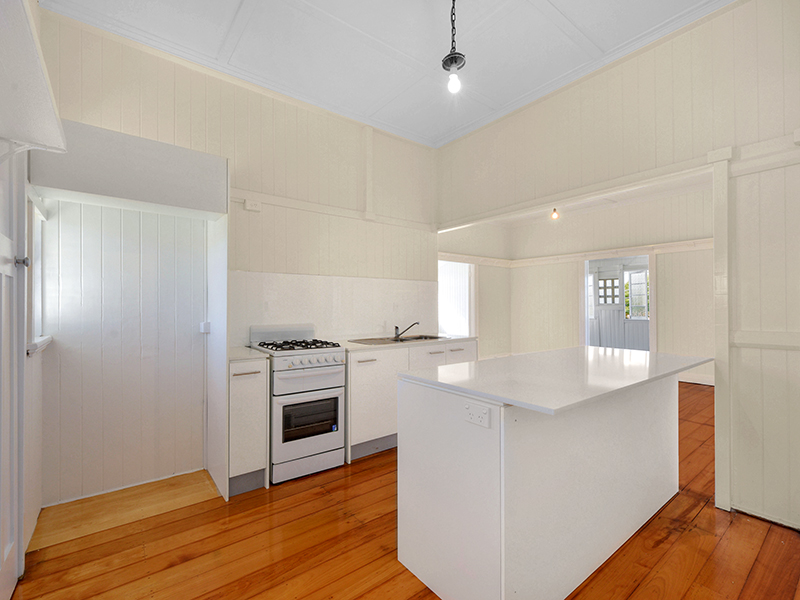
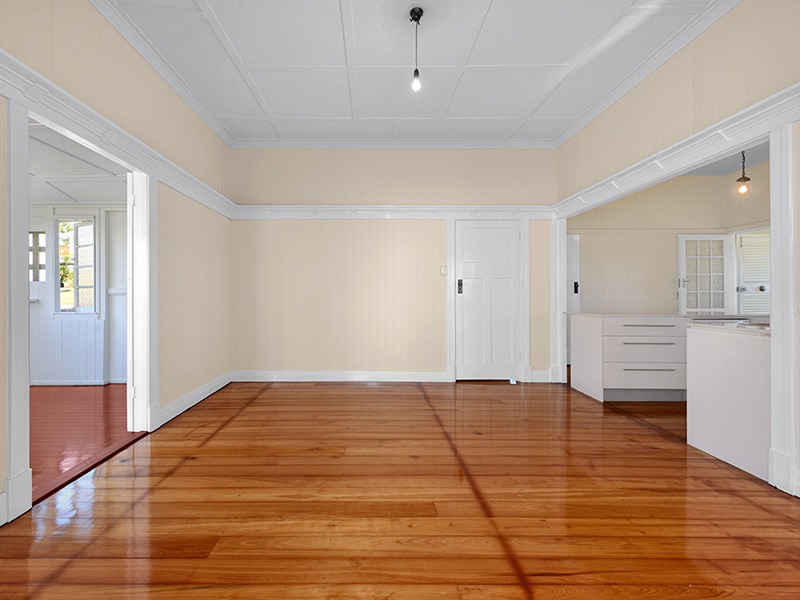
Image 10 – New study and dining room
Note carpet has been removed and new floorboards installed in both rooms. What was previously a storage area in terrible condition can now be used as a legitimate study.
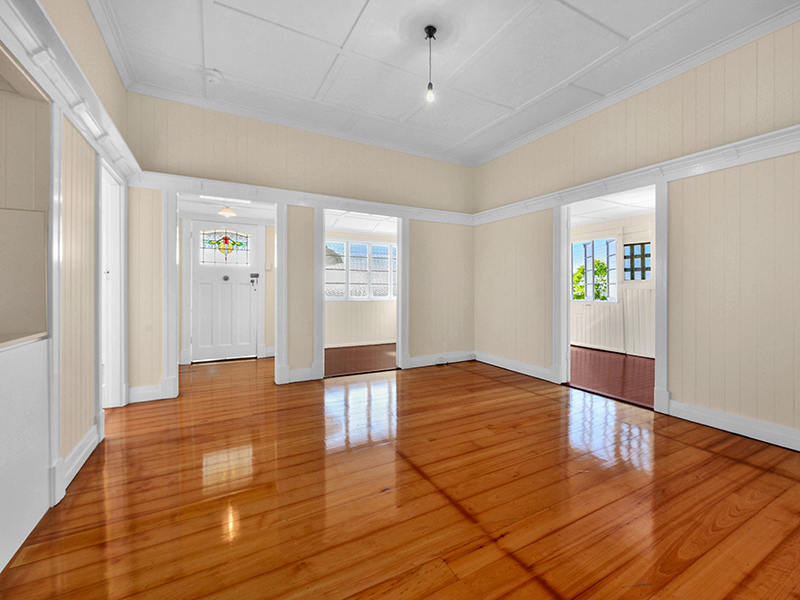
Image 11 – New dining area with new bay windows
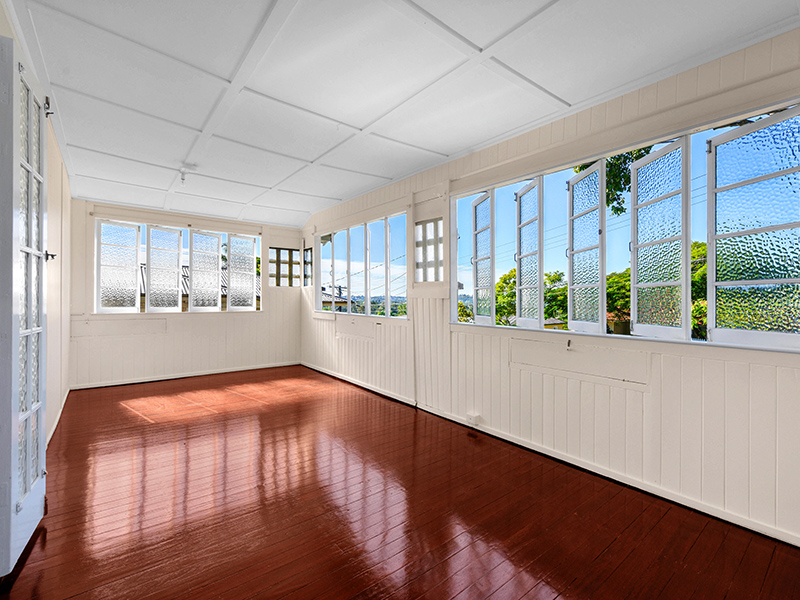
Image 12 – Third bedroom (previously the dining room)
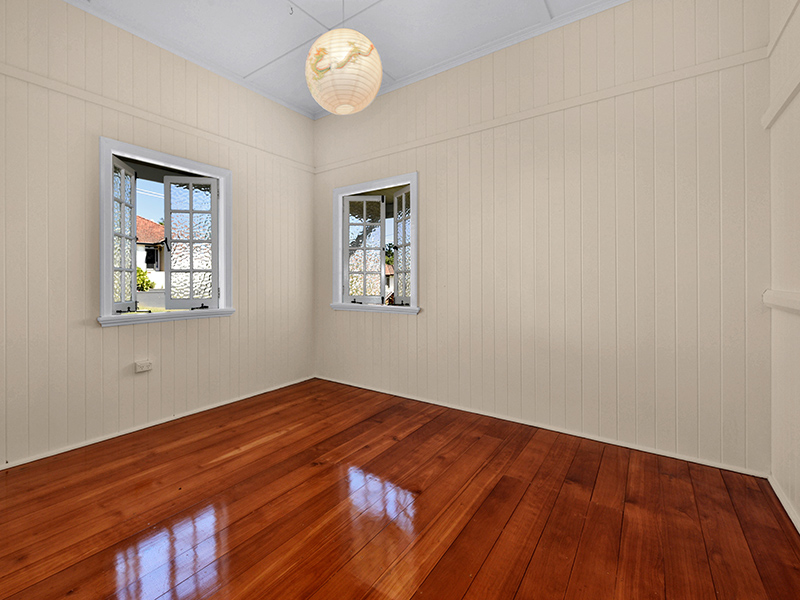
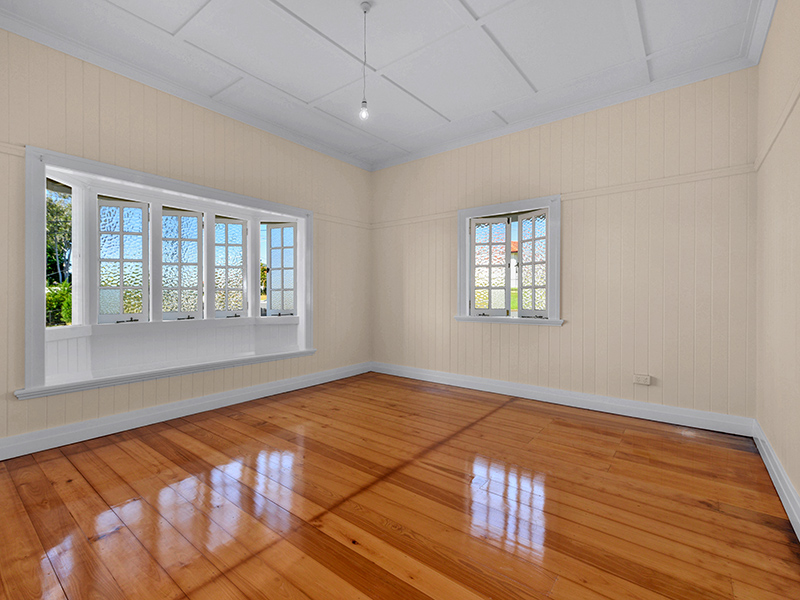
Image 13 – Master bedroom with new bay windows
Updated bathroom. Unfortunately no photo is available of the updated bathroom however the works included the installation of a new vanity/basin, new shower curtain and rail, new mirror/shaving cabinet for extra storage and paint work.
The proper bathroom renovation is planned for 3-5yrs.
—
After the renovation the property was rented within 2 weeks at $425/wk, implying a gross yield of (425 x 52 / 692,500) = 3.2%
By way of comparison, the fully renovated art deco apartment in Elwood has a gross yield of 3.2%. (despite being more of yield play than a growth play).
Most growth based investments in Melbourne have yields closer to 2.0-2.5% p.a. This further highlights the difference between the investment opportunities currently available in Melbourne and Brisbane.
The investor here happened to be Melbourne based, and the property was purchased by a buyers advocate operating on-the-ground in Brisbane.
The referral came from the finance adviser who over the years has head-hunted the best property experts in the country, each top of their respective fields.
The buyers advocate charged their standard fee to locate, negotiate and acquire the Brisbane property.
After the purchase they then made recommendations for the initial renovation in terms of what would add the most amount of value but still remain within budget.
They then obtained quotes from reliable builders they had worked with previously, then once everything was agreed they actually project managed the entire renovation process for no extra charge.
Before committing to the purchase, over the course of approximately 2 months the Melbourne based investor reviewed 5 or 6 investment reports on potential houses recommended by the advocate.
Once the right property was identified their total time commitment was no more than about 20 hours all up.
To purchase, renovate and then tenant a property from interstate, all with about 20 hours of total work, is very impressive.
All in all the entire process far less stressful, far less time consuming, and far lower risk than had the investors tried to do everything themselves.
Will it work out, and deliver the forecast growth?
It’s impossible to know for sure, but the investment process was very sensible, so the chances of success have definitely been maximised.
Similarly with so many opportunities to manufacture growth (e.g. through the kitchen/bathroom renovations, raising the house, installing the new bedroom + rumpus room + bathroom downstairs, the potential subdivision and then eventually the new build), the downside risks have clearly been mitigated as well.
* In August 2016 the property got revalued by CBA at $750,000, this created $37,500 equity which was then used for a deposit on another property.

Great article. Very informative especially when it came to proper due diligence in relation to potential subdivision and further wealth creation.
Thanks Dom, yes we had good consultants involved and our experience with the Brisbane City Council Risk Smart service was positive.